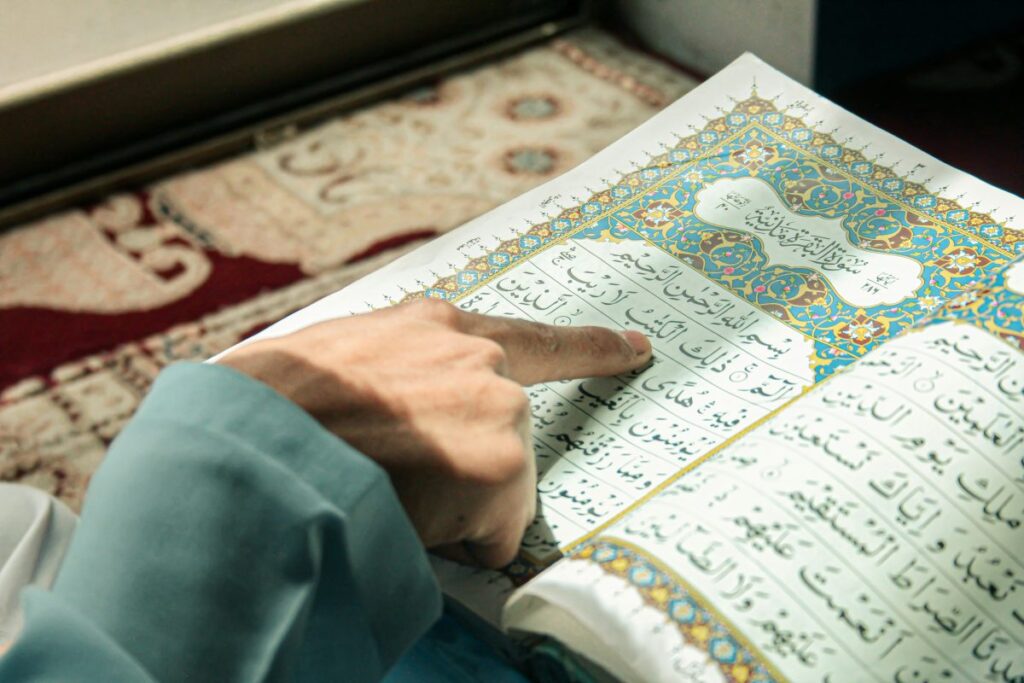
Recitation of Holy Quran is a direct communication between the servant and Allah, not merely a routine. Every phrase calms the heart, and every letter repeated delivers a reward. However, genuine recitation necessitates presence, comprehension, and accurate pronunciation in addition to tongue movement.
Recitation of Holy Quran

As a profound, contemplative act of devotion, Recitation of Holy Quran (Qira’at or Tilawah) entails reading the sacred book with correct pronunciation, rhythm, and comprehension of Tajweed (rules of recitation). It is more than just reading; it is a source of calm, a spiritual bond with Allah, and a manual for day-to-day living.
This is an explanation of what it actually means:
- A Spiritual Bond & Worship: Recitation is seen to be the most effective way to remember Allah (dhikr), bringing the believer closer to their Creator.
- Active Engagement with Divine Words: This is repeating the Quran either silently or out loud while, ideally, considering its meanings to enable it to have an effect on the heart and spirit.
- Adhering to Tajweed standards: To pronounce Arabic words correctly during a true recitation, one must adhere to Tajweed’s phonetic and morphological standards.
- A Transformative Experience: It is seen as a guide that molds character, offers spiritual, moral, and emotional support, and calms the heart.
- A Method of Intercession: According to the Prophet Muhammad (peace be upon him), on the Day of Judgment, the Quran will make a plea on behalf of its companions, or those who read it.
- Learning and Reflection: It involves more than just reading; it also entails comprehending, researching, and putting the lessons of the Quran into practice.
In conclusion, recitation of Holy Quran entails cultivating a daily, respectful, and contemplative connection with the holy word, which is meant to direct, heal, and elevate the reciter both here on Earth and in the hereafter.
The Advantages of Recitation of Holy Quran
- Spiritual growth and awards: For every letter that is repeated, ten or more prizes are given out. On Judgment Day, it serves as a source of intercession and a barrier against evil.
- Mental and Emotional Health: The Quran provides significant, empirically supported decreases in depression, anxiety, and stress. It fosters tolerance, thankfulness, emotional stability, and inner serenity.
- Physical Well-Being: Research shows that reciting or listening to the Quran helps reduce blood pressure and pulse rate. When Tajweed is used, it may also serve as a breathing exercise that improves lung health.
- Cognitive Benefits: Consistent participation improves cognitive function and sharpens memory.
- Protection & Guidance: It protects one’s house and family and acts as a guide to the proper way.
Advice for Everyday Recitation
- Consistency: It is quite fulfilling to recite a few verses every day.
- Understanding: The spiritual bond is strengthened by thinking about the meanings.
- Correct Technique: Mastering the pronunciation of Tajweed improves the experience and offers respiratory and bodily advantages.
Quranic recitation for families residing overseas
Maintaining a link to the Quran is essential for Muslim families residing overseas in order to preserve their religion and identity.
This is frequently accomplished through specialized internet platforms, virtual academies, and remote services made for hectic, diverse settings.
To guarantee that both adults and children may interact with the Quran even in situations where local resources are limited, these programs concentrate on Tajweed (accurate pronunciation), Hifz (memorization), and Tafseer (interpretation).
Families residing overseas can participate in the recitation of holy quran in the following important ways:
Online Tutors & Academies for the Quran
- Structured Learning: Schools such as Alam Nashrah and Al Sarh Academy guarantee competent recitation within 30 days and provide customized, one-on-one, and group sessions for children and adults.
- Qualified Tutors: Many platforms provide licensed instructors who specialize in teaching non-native speakers. These instructors are frequently from Al-Azhar University or local Arabic-speaking nations.
- Flexibility: Classes are made to accommodate different time zones (such as those in North America or Europe) and school hours, enabling regular, consistent interaction with the Quran.
- Interactive Tools: Children find learning interesting when PowerPoint, instructional games, and digital whiteboards are used.
Remote Programs and Services
- Specialized Programs: Every year, organizations like Itqan Academy organize comprehensive programs that concentrate on integrating the Quran into everyday family life.
- Holiday Programs: Children from the diaspora are targeted by specialized facilities, like those in Morocco, to deepen their religious ties throughout the summer.
Making Your House Quran-Friendly
- Audio Atmosphere: To fully immerse the family in the Quran, it is advised to play Quran audio at home.
- Family Sessions: Fostering love for the Quran can be achieved by establishing a practice where the entire family gathers together to recite or listen, seeing it as a bonding activity rather than a rigorous instruction.
- Pay Attention to Duas: Children can better integrate the Quran into their daily life by learning daily duas for protection and guidance, such as those found in Surah Al-Furqan, 25:74.
Overcoming Obstacles
- Consistency: Daily or three-times-weekly brief sessions work better for retention than sporadic, once-weekly training.
- Interactive Learning: Giving young children games and incentives keeps them interested.
For Muslim families living overseas, our programs of recitation of Holy Quran offer an essential, easily available, and organized way to have a close, active relationship with their faith and the Quranic heritage.
How to Get Better at Recitation of Holy Quran
- Consistent Practice: Make time each day to read for at least 15 to 30 minutes, ideally after Fajr or Maghrib.
- Learn Tajweed: To prevent changing meanings, learn the laws of pronunciation, stretching (Madd), and halting places (Waqf).
- Listen and Imitate: To learn appropriate rhythm, intonation, and melody, often listen to skilled reciters (Qaris).
- Record and Review: Record your recitation using your phone, then listen carefully to pinpoint areas that need work.
- Begin Small: Prioritize learning short surahs by employing “intelligent repetition”—repeating the same page several times before going on.
- Understand Meaning: Proper pauses, emotional tone, and engagement are all aided by studying the Tafsir (explanation).
- Seek a Teacher: Learning from a trained instructor guarantees correct pronunciation and offers prompt feedback.
- Maintain Your Voice: Stay hydrated and refrain from yelling or straining your voice.
To train your voice and increase the fluency of your recitation, you must be patient and consistent.
Sincerity and effort are more important while reciting the Holy Quran than having the most beautiful voice.
Begin modestly. Continue to be consistent. And let Allah’s teachings mold your house and your heart. And be assured that Itqan Academy will help you with all of that.