What is tajweed in arabic? Tajweed is a means of preserving the holy message, comprehending the Quran holistically, and engaging in spirituality through the word of Allah. Its significance in Quranic Arabic goes well beyond simple exemplary recitation. Tajweed is about respecting, defending, and abiding by the holy and sacred language of the Quran, not merely how we “sound.” This essay examine over how Tajweed influences various aspects of reading the Quran and why learning is essential at all levels.
What is tajweed in Arabic?
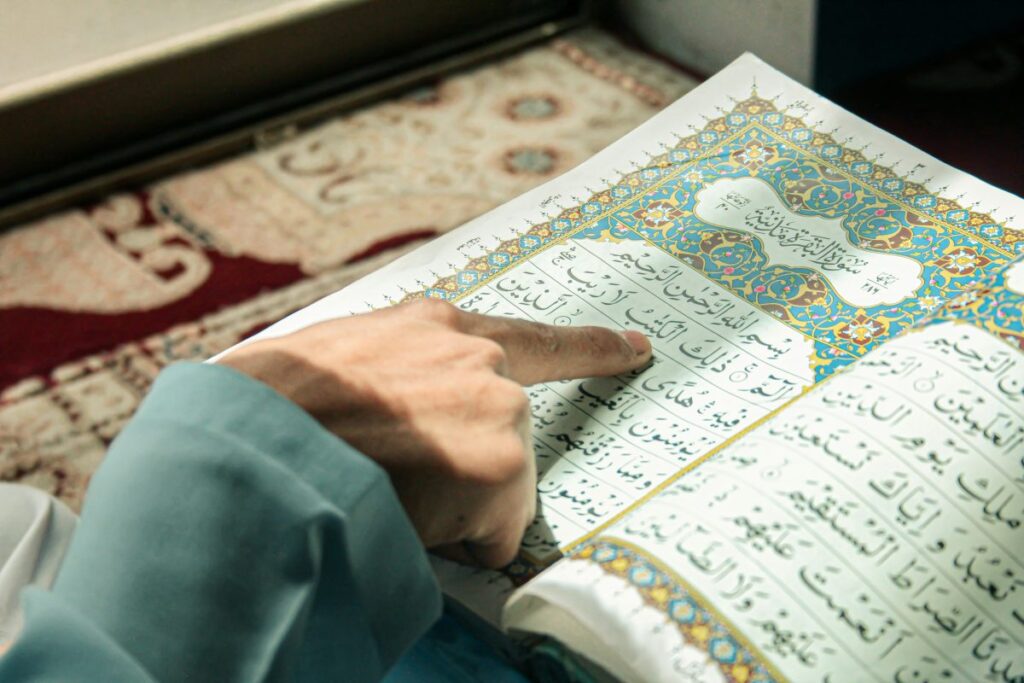
The principles governing the proper pronunciation and recitation of the Quran are known in Arabic as tajweed. What is tajweed in arabic?
The Arabic origin of the term “Tajweed” means “to improve” or “to make better.” When reciting the Quran, Tajweed makes sure that each letter is pronounced correctly and from its exact articulation point.
Learning Tajweed maintains the truth and beauty of the holy book while assisting Muslims in reciting the Quran as it was delivered.
Why Is Learning Tajweed Important?
Allah (SWT) speaks to all people via the sacred Quran.
It includes references to the Hereafter as well as information, guidelines, and suggestions regarding every facet of life. But the question here is what is tajweed in Arabic, and why is learning it important? Therefore, it is crucial to recite the Quran with Tajweed to prevent mispronouncing Allah’s (SWT) verses.
In fact, a single letter error might lead to a misinterpretation of the entire verse (ayah). Understanding the tajweed laws enables us to pronounce the Arabic alphabet precisely so that our phrases convey the desired meaning.
For instance, it teaches us that the pronunciation of “ص” and “س ” differs, and that when you mix them up in sentences, you may end up saying one thing while meaning another. Furthermore, as it is Fard Ayn, reading the Quran with Tajweed is truly required of all Muslims. During daily prayers, every Muslim should recite the Quran with tajweed.
How Can I Learn Tajweed Online?
It is crucial for all Muslims to know what is tajweed in arabic by learning tajweed. Therefore, even if we are just starting, we should never be reluctant to do so.
- Begin with the fundamentals:
Take note of how the Arabic letters differ in terms of size, form, and nuqta. Learn the fundamental guidelines for pronouncing each letter and attempt to pronounce them correctly.
- Examine the regulations:
Learn everything there is to know about Tajweed, including the many kinds of harakat (vowels), articulation, intonation, and application guidelines. Learn how to combine and compound words and phrases.
- Regular practice:
Regular practice is essential to becoming proficient at Tajweed. Even if it’s just for a little while, try to read the Quran every day.
- Play recordings:
To learn how the words should be spoken, listen to recordings of the Quran recited by proficient Qaris and Tajweed reciters. For challenging words, you may also try imitating them.
- Obtain comments:
Look for a teacher or tutor who can fix any errors in your pronunciation and provide you with feedback.
- Have patience and never give up:
It takes time and practice to learn Tajweed. When you make errors, be kind to yourself and try not to be too hard on yourself. Keep in mind that making errors will only help you grow, and Allah will bless you for even attempting!
- With the meaning in mind, read:
It will be simpler for you to comprehend and apply the tajweed guidelines if you try to read the Quran with its meaning in mind.
Enroll in an offline or online course: You may learn Tajweed through various online and offline courses; choose one based on your availability and preferred method of learning, like Itqan Academy. Regardless of where you live, the online course allows you to study with local Arabic teachers.
How to Improve Your Tajweed
Even if we already know what is tajweed in arabic and the fundamentals of Tajweed are, it still takes some practice to become familiar with it. Here are some pointers to help you get better at Tajweed.
- Prioritize your pronunciation. Understanding the letters, their sounds, and how to pronounce them can help you recite them more effectively. Therefore, to properly blend Arabic letters in the following classes, you must first learn how they sound.
- Pay attention to your tone. Your voice and sound are just as important as the reading’s rise and fall. You must learn and comprehend when to turn up the volume, slow down, and stop to perfect your recitation.
- Master Waqf and other indicators. Since each sign is a component of Tajweed, we should understand its significance when we read the Quran. Because stop, continue, and pause indicators affect the meaning of the poem, it is important to pay attention to them in addition to proper pronunciation and intonation.
- Enhance your Tajweed with the assistance of a qualified educator. Online courses can help you achieve perfection in your Tajweed. To enhance your Tajweed, you may thus sign up for an online course or work with an online trainer like Itqan Academy.
The Relationship Between Classical Arabic and Tajweed
Understanding what is tajweed in arabic and how much Tajweed relies on classical Arabic is essential to appreciating its significance in Quranic Arabic. Tajweed is more than just a collection of phonetic principles; rather, it is a degree of restriction that physically extracts its richness, beauty, and precision from its entirety rather than its exact pronunciation.
In contrast to today’s multi-typed Arabic dialects, which do not rely on precise enunciation to keep their sense, classical Arabic, as found in the Quran, places itself in a vast vocabulary, complete grammar, and rigid phonetics that allow meaning to be correct.
Tajweed meets this demand. The reader can repeat each letter from its limited beginning point (makhraj) with its corresponding qualities (sifaat) thanks to the limitations of Tajweed and the organic rhythms and patterns of Quranic Arabic. For this reason, maintaining classical Arabic in its finest form is closely linked to the significance of Tajweed in Quranic Arabic.
Without Tajweed, students could inadvertently include elements from contemporary languages that change the rhythm and timbre of Quranic recitals. This diminishes the spiritual experience that comes with reading the Quran in its original form, in addition to impairing the recitation’s accuracy.
Students who study Tajweed are more likely to pronounce the Quran correctly, which is also the most elegant and potent form of classical Arabic. It is yet another compelling argument for the significance of Tajweed in Quranic Arabic for the advancement of both language and religion.
To sum up, Tajweed acts as a link between contemporary students and the timeless elegance of traditional Arabic. Tajweed enables us to read the Quran exactly as it was intended to be—word for word, sound for sound, and heart for heart. Now is the time to study Tajweed with Itqan Academy.