Tajweed guarantees that the Quran is recited accurately, beautifully, and according to what was given to the Prophet ﷺ. What is Tajweed in Quran? The definition of Tajweed, its significance, and how it strengthens your relationship with the Quran are all covered in this blog. Discover its background, fundamental guidelines, and how to begin your Tajweed adventure right now.
What Is Tajweed in Quran?

Though many Muslims read the Quran every day, not everyone is aware of Tajweed’s significance. What is Tajweed in Quran? What does Tajweed mean in the Quran, and why is it important? The collection of guidelines known as Tajweed instructs us how to accurately recite the Quran, just as it was given to the Prophet Muhammad ﷺ.
Acquiring knowledge of Tajweed shields Allah’s verses from errors and enhances recitation.
Tajweed: What Does It Mean?
The Arabic root “j-w-d” (ج-و-د), which means to “make something excellent” or “improve,” is the source of the term “Tajweed” (تَجْوِيد). Tajweed, as used in the context of the Quran, refers to the set of guidelines that control how the words are spoken and articulated.
These guidelines guarantee accurate recitation of every letter and sound, maintaining the accuracy and elegance of the Quranic text.
Tajweed is a complete technique that preserves the rhythm, fluidity, and eloquence of Quranic recitation; it goes beyond simple pronunciation. Reciters may ensure that every listener comprehends and experiences the full effect of Allah’s words by using Tajweed to transmit the profound meaning of the Quran as it was revealed.
What is Tajweed in Quran & Why Does Tajweed Matter?
Tajweed is crucial for learning and reciting the Holy Quran as it was revealed to our Prophet Muhammad, peace be upon him. There are several indications that it may be significant:
- Respect God’s Words: By teaching people how to pronounce the words correctly, as God intended, Tajweed honors and respects the Holy Quran.
- Preventing Shifts in Belief: Tajweed protects us from pronunciation mistakes, which can have a significant impact on meaning.
- Strong Meditation and Pondering: Tajweed gives the Quran strong significance, which deepens meditation and contemplation for both the reciter and the listener.
- Preserving the Beauty of the Quran: Tajweed assists in maintaining the beauty of the Holy Quran, which was revealed in elegant and lovely Arabic.
- Enhancing Focus and Memory: Tajweed practice improves focus and memory.
- Ummah Coming Together: Tajweed united all Muslims in order to pronounce the Book of Allah SWT correctly.
Essential Tajweed Guidelines Every Novice Should Understand
Beginner-friendly Tajweed rules emphasize proper letter pronunciation (Makharij), nasal sounds (Ghunnah), extending vowels (Madd), and letter features such as Tafkheem/Tarqeeq (heavy/light letters) and Qalqalah (echoing). By regulating articulation sites in the throat, tongue, and lips, mastering these criteria guarantees precise, rhythmic Quranic recitation.
What is Tajweed in Quran & Fundamental Tajweed Rules for Beginners?
- Makharij al-Huroof (Articulation Points): The most important way to prevent word meanings from altering is to pronounce each letter from its proper origin (throat, tongue, lips).
- Noon Sakinah and Tanween: Rules controlling the behavior of a “ن” without a vowel or multiple vowels, such as concealing, merging, or clarifying the sound.
- Meem Sakinah: Rules for “م” that determine whether it is concealed, merged, or clear when it has a sukoon (no vowel).
- Ghunnah: A required two-beat nasal sound made under specific Ikhfaa/Idghaam regulations or when a Noon or Meem with a Shaddah (ّ) is encountered.
- Qalqalah (Echoing): When five letters (ق, ط, ب, ج, د) have a Sukoon, they generate an echoing sound.
- Extending certain vowel sounds (typically for two, four, or five counts) is known as al-madd (lengthening).
- Heavy and Light Letters: Differentiating between letters with a light sound (Tarqeeq) and those with a full mouth (heavy/Tafkheem).
- Waqf (Stopping): How to pause during recitation in a way that preserves rhythm and significance.
Advice for Novices:
- Listen and Repeat: For proper application, regular, guided listening to a Qari (reciter) is essential.
- Prioritize Makharij: Before concentrating on more complex rules, master articulation points.
- Slow Recitation: To properly use these criteria, put accuracy above speed.
Why is learning the basics of Tajweed so crucial for non-Arabic speakers?
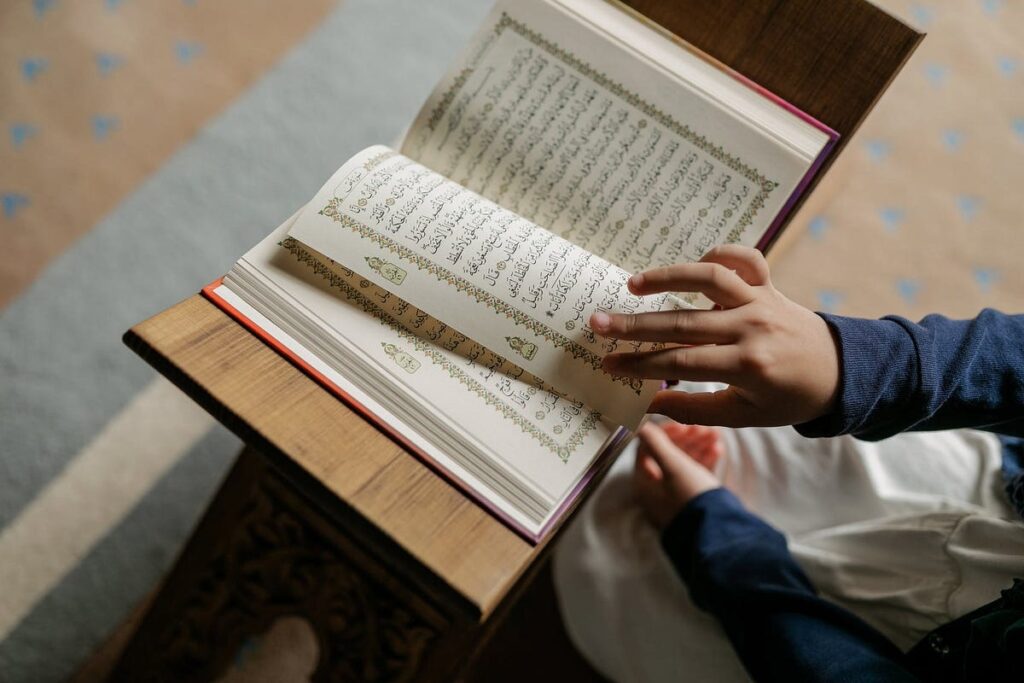
What is Tajweed in Quran? For non-Arabic speakers who want to recite the Holy Quran precisely and gracefully, learning Tajweed is an essential path. Tajweed is essential to reciting the Quran because mispronouncing words can change their meanings.
Advice for Novices:
- Listen and Repeat: For proper application, regular, guided listening to a Qari (reciter) is essential.
- Prioritize Makharij: Before concentrating on more complex rules, master articulation points.
- Slow Recitation: To properly use these criteria, put accuracy above speed.
Why is learning the basics of Tajweed so crucial for non-Arabic speakers?
For non-Arabic speakers who want to recite the Holy Quran precisely and gracefully, learning Tajweed is an essential path. Tajweed is essential to reciting the Quran because mispronouncing words can change their meanings.
It is essential to comprehend the Arabic language’s phonemes and Tajweed principles to effectively apply them.
Acquiring Tajweed presents several difficulties for non-Arabic speakers, including acquiring the distinctive Arabic vowels, sounds, and consonants. It may take some time for students to become adept at pronouncing these sounds correctly, as it requires constant practice and commitment.
How to Begin Studying Tajweed
Even though Tajweed can initially appear difficult, there are many materials available nowadays to make the process simpler.
In the past, learning Tajweed required an instructor who could walk you through each letter’s features and articulation points. In addition to instructors, there are also books, DVDs, and internet resources that offer detailed instruction on Tajweed regulations.
It’s crucial for beginners to concentrate on learning the fundamentals initially, then progressively improve their abilities over time.
Consistent practice is essential, and recording your recitation will help you identify errors and enhance your pronunciation. Joining Tajweed lessons or study groups, where they may get assistance and criticism, is beneficial for many students.
What is Tajweed in Quran? Tajweed is an essential component in establishing a connection with the Quran, not only a collection of guidelines.
We may reverence the Quran and its message, recite more accurately, and enhance our spiritual experience by learning and using Tajweed. Learning Tajweed is now easier than ever thanks to the abundance of resources available.
Thus, begin your Tajweed adventure now and discover the beauty of the Quran as you have always desired with Itqan Academy.