
Dua For Thunder offers Muslims a meaningful way to remember Allah’s greatness and seek His protection during thunderstorms. In Islam, thunder and lightning are signs of Allah’s power, encouraging believers to reflect, engage in dhikr, and turn to Him through sincere supplication.
Islamic teachings also provide specific duas for beneficial rainfall and protection from severe weather, helping Muslims strengthen their faith while teaching children Islamic manners and appropriate safety precautions.
Dua For Thunder | What to Say Upon Hearing Thunder
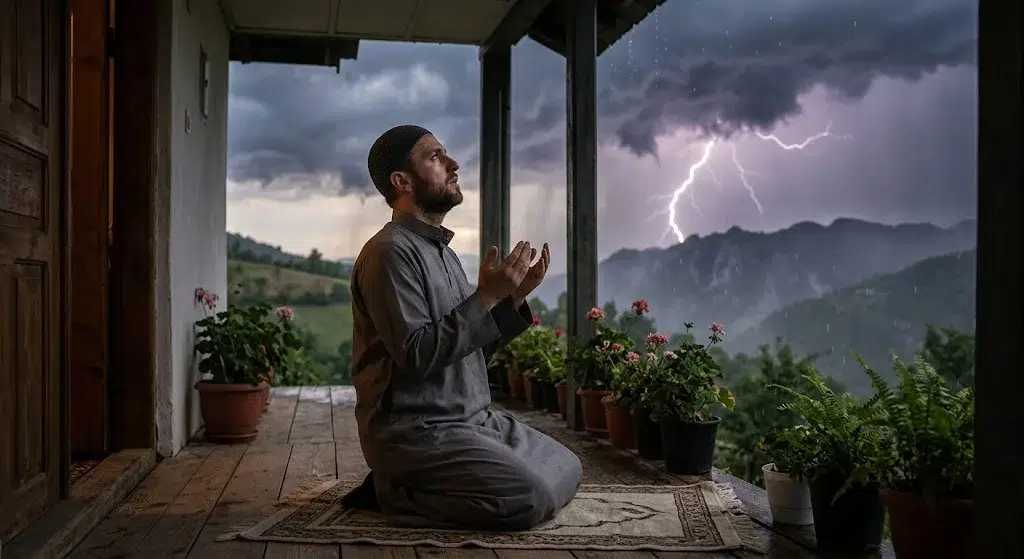
When thunder rumbles across the sky, Muslims are encouraged to remember Allah and reflect on His power. One supplication commonly recited upon hearing thunder is reported from Abdullah ibn Al-Zubayr (may Allah be pleased with him), who would stop speaking and glorify Allah when he heard it.
The supplication is based on the Quranic description of thunder glorifying Allah with His praise, alongside the angels out of awe of Him. It is recorded in Al-Muwatta of Imam Malik as a practice of Abdullah ibn Al-Zubayr. However, this report describes his practice rather than establishing a direct prophetic instruction specifically prescribing these words for every occurrence of thunder.
The Exact Arabic Text and English Translation
The following is the Arabic text of the Dua for Thunder, recited upon hearing thunder.
سُبْحَانَ الَّذِي يُسَبِّحُ الرَّعْدُ بِحَمْدِهِ وَالْمَلَائِكَةُ مِنْ خِيفَتِهِ
“Subhana alladhi yusabbihur-ra’du bihamdihi wal-mala’ikatu min kheefatihi.”
“Glory be to the One whom the thunder glorifies with His praise, and the angels out of awe of Him.”
This supplication expresses the perfection and greatness of Allah. It reminds believers that all creation glorifies its Creator in ways appropriate to its nature, even when human beings cannot fully comprehend them.
Dua for Thunder: Supplication for Protection from Allah’s Wrath
Another supplication associated with the Dua for Thunder in Islamic hadith literature seeks Allah’s mercy, protection, and well-being during times of fear and hardship.
“اللَّهُمَّ لَا تَقْتُلْنَا بِغَضَبِكَ وَلَا تُهْلِكْنَا بِعَذَابِكَ وَعَافِنَا قَبْلَ ذَلِكَ”
“Allahumma la taqtulna bighadabika wa la tuhlikna bi’adhaabika wa ‘aafina qabla dhalik.”
“O Allah, do not destroy us with Your wrath or punish us with Your punishment, and grant us well-being before that.”
This supplication is reported in Al-Adab Al-Mufrad and Jami‘ at-Tirmidhi. Its meaning reflects humility before Allah and a sincere request for His mercy, protection, and safety from harm.
Understanding the Meaning of Dua Hearing Thunder
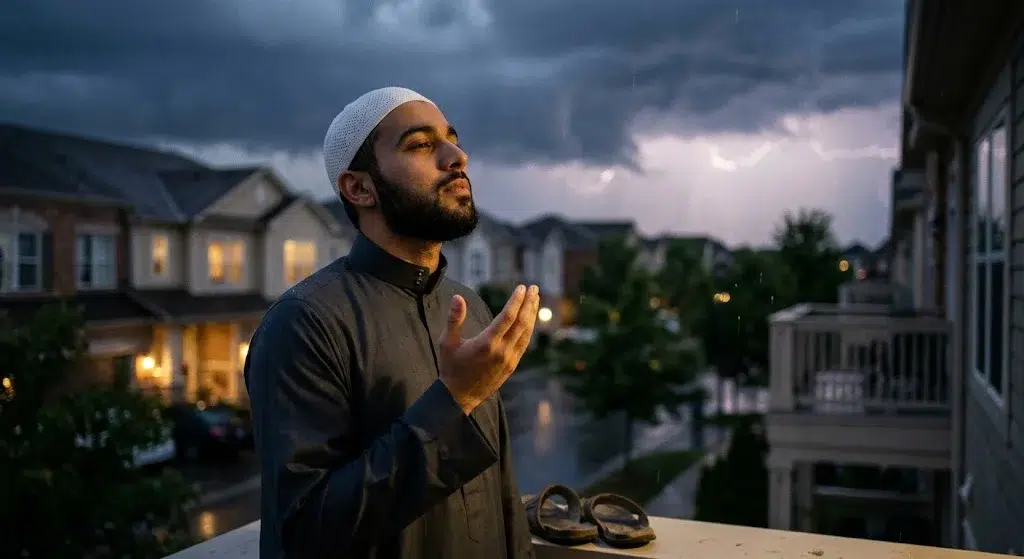
The meaning of Dua For Thunder goes beyond recitation, reminding Muslims of Allah’s greatness and their need for His mercy and protection. The phrase “Subhana alladhi” means “Glory be to the One,” while the following words describe thunder glorifying Allah with His praise and the angels glorifying Him out of awe.
This remembrance reflects Surah Ar-Ra’d (13:13), which affirms that thunder glorifies Allah and the angels praise Him out of reverence. Reflecting on this verse can help believers respond to thunder with remembrance rather than fear, while distinguishing established Islamic supplications from personal prayers for safety and relief.
The Prophetic Guidance Upon Hearing Thunder and Seeing Lightning
The Prophet Muhammad (peace and blessings be upon him) would seek Allah’s protection upon seeing clouds on the horizon and express gratitude when rain fell, supplicating to Allah by saying:
“اللَّهُمَّ صَيِّبًا نَافِعًا”
“Allahumma sayyiban naafi’an.”
“O Allah, make it beneficial rain.”
This well-known supplication asks Allah to make the rain beneficial and free from harm. When the clouds dispersed without rainfall, the Prophet (peace and blessings be upon him) praised Allah. These teachings emphasize remembrance, gratitude, and seeking Allah’s protection while taking practical precautions during thunderstorms, lightning, and heavy rain..
Why the Prophet (PBUH) Stopped Talking During Thunder
The practice of pausing conversation upon hearing thunder is attributed to Abdullah ibn Al-Zubayr (may Allah be pleased with him), as reported in Al-Muwatta by Imam Malik. He would recite:
“Glory be to the One whom the thunder glorifies with His praise, and the angels out of awe of Him.”
He regarded thunder as a serious warning for the inhabitants of the Earth. This practice reflects reverence for Allah and encourages remembrance and contemplation of His creation. The Quran, in Surah Ar-Ra’d (13:13), also describes thunder as glorifying Allah with His praise.
Connecting Weather Events with Islamic Remembrance
Islam encourages Muslims to remember Allah during different weather conditions, including rainfall, strong winds, and thunderstorms. Each event offers an opportunity to seek Allah’s mercy, express gratitude, and ask for protection from potential harm.
These practices connect daily experiences with worship and help believers maintain a consistent relationship with Allah.
What to Recite Alongside Dua for Rain and Storms
Alongside Dua For Thunder, several supplications are reported for rainfall and severe weather, each serving a distinct context and purpose.
| When rain begins | اللَّهُمَّ صَيِّبًا نَافِعًا | Allahumma sayyiban naafi’an.
“O Allah, send beneficial rain.” |
| During heavy rainfall | اللَّهُمَّ حَوَالَيْنَا وَلَا عَلَيْنَا، اللَّهُمَّ عَلَى الْآكَامِ وَالْجِبَالِ وَالْآجَامِ وَالظِّرَابِ وَالْأَوْدِيَةِ وَمَنَابِتِ الشَّجَرِ | Allahumma hawalayna wa la ‘alayna. Allahumma ‘alal-aakami wal-jibali wal-aajami wadh-dhirabi wal-awdiyati wa manabitish-shajar.
“O Allah, let the rain fall around us, not upon us. O Allah, send it upon the plateaus, mountains, hills, valleys, and places where trees grow.” |
| During strong winds and storms | اللَّهُمَّ إِنِّي أَسْأَلُكَ خَيْرَهَا وَخَيْرَ مَا فِيهَا وَخَيْرَ مَا أُرْسِلَتْ بِهِ، وَأَعُوذُ بِكَ مِنْ شَرِّهَا وَشَرِّ مَا فِيهَا وَشَرِّ مَا أُرْسِلَتْ بِهِ | Allahumma inni as’aluka khayraha wa khayra ma fiha wa khayra ma ursilat bihi, wa a’udhu bika min sharriha wa sharri ma fiha wa sharri ma ursilat bihi.
“O Allah, I ask You for its goodness, the goodness within it, and the goodness of what it was sent with. I seek refuge in You from its evil, the evil within it, and the evil of what it was sent with” |
| After rainfall | مُطِرْنَا بِفَضْلِ اللَّهِ وَرَحْمَتِهِ | Mutirna bi-fadlillahi wa rahmatih.
“We have been given rain by the grace and mercy of Allah.” |
Teaching Children How to React to Thunder and Storms
Thunderstorms can frighten children, making them an opportunity to teach Islamic remembrance in a calm, reassuring way. Parents should acknowledge their fears and explain that Muslims can remember Allah and seek His protection during difficult moments.
- Teach a short supplication: Introduce Dua For Thunder, Subhana alladhi yusabbihur-ra’du bihamdihi wal-mala’ikatu min kheefatihi, and explain its meaning in simple terms.
- Practice regularly: Recite the supplication together during calm moments to help children learn its pronunciation and meaning.
- Explain the Islamic perspective: Teach children that the Quran describes thunder as glorifying Allah, encouraging reflection on His greatness and creation.
- Promote reassurance: Explain that remembrance can provide spiritual comfort while adults take steps to ensure everyone’s safety.
- Teach storm safety: Encourage children to stay indoors, keep away from windows, and never go outside to watch lightning.
Building Spiritual Resilience Through Islamic Education with Itqan Network
Consistent Islamic education helps children understand worship, daily supplications, and Islamic manners. Learning the meanings of duas alongside memorization strengthens their faith and encourages regular dhikr.
Structured Quran and Islamic studies programs can help children improve Arabic pronunciation, learn authentic supplications, and distinguish between Quranic teachings, prophetic narrations, and personal prayers.
Itqan Network offers an educational option for families seeking guided Islamic learning, including Quran recitation, daily duas, and Islamic studies with qualified tutors. Parents can review its programs and tutor qualifications to find the right fit for their children.
The aim is to help children appreciate the importance of remembering Allah, approach unfamiliar experiences with confidence, and combine spiritual awareness with responsible action.
FAQ About Dua For Thunder
What is the authentic dua to say upon hearing thunder?
A commonly recited supplication is Subhana alladhi yusabbihur-ra’du bihamdihi wal-mala’ikatu min kheefatihi. It is reported as the practice of Abdullah ibn Al-Zubayr (RA) in Al-Muwatta of Imam Malik, reflecting the Quranic description of thunder glorifying Allah.
Is there a specific prayer or dua for rain and heavy storms?
Yes. When rain begins, Muslims can recite Allahumma sayyiban naafi’an, asking Allah for beneficial rainfall. During heavy rain, Allahumma hawalayna wa la ‘alayna is reported in Sahih al-Bukhari as a supplication asking for rain to fall around rather than upon people.
How should a Muslim react upon hearing thunder?
A Muslim can remember Allah, recite an appropriate supplication, and reflect on His greatness. It is also important to remain calm, seek safe shelter, stay away from exposed areas, and follow official weather guidance during thunderstorms.
How can I help my children learn daily duas and Islamic manners?
Teach children short supplications with their meanings, practice them regularly, and explain when each is appropriate. Structured Islamic education, including Quran recitation and Islamic studies through programs such as Itqan Network, may also support their learning.