
Learning Quran Tajweed rules When We Talk About What Is Tajweed Rules is essential for Muslims who want to recite the Holy Quran accurately and preserve the correct pronunciation of its words. Tajweed provides a structured approach to articulating Arabic letters, observing their characteristics, applying elongation rules, and maintaining the appropriate rhythm during recitation. Whether you are a beginner or looking to improve your Quran recitation, understanding Tajweed can help you develop greater accuracy, confidence, and appreciation for the words of Allah.
This comprehensive guide explains the fundamental Tajweed rules, Quranic symbols, stopping signs, and practical methods for learning and memorizing them.
what is tajweed rules?

Tajweed linguistically means improvement and perfection. In Quranic recitation, it refers to pronouncing every Arabic letter from its correct articulation point (makhraj) while observing its permanent characteristics, such as whispering, voicing, and elevation, and its applicable characteristics, including elongation, nasalization, and heavy or light pronunciation.
The primary purpose of Tajweed is to protect the tongue from errors when reciting the Quran. Learning its rules collectively is a communal obligation, while reciting the Quran with correct Tajweed is considered an individual obligation according to the principles presented in traditional Tajweed instruction.
Tajweed knowledge is derived from the Quran, Sunnah, and the transmitted recitation practices of the Companions and their successors. Its practical application helps Muslims approach Quranic recitation with care, understanding, and reverence.
Important Tajweed Rules of the Quran
Several foundational rules govern how Arabic letters interact during Quranic recitation. These include the rules of Noon Sakinah, Tanween, Meem Sakinah, nasalization, and elongation.
What Is Tajweed Rules Of Noon Sakinah and Tanween
Noon Sakinah is a noon without a vowel that remains present in pronunciation and writing, whether reading continuously or stopping. Tanween is an additional silent noon sound at the end of a noun, pronounced but not represented as a separate noon letter in writing.
Both have four principal rules: Izhaar, Idghaam, Iqlaab, and Ikhfaa. Identifying these rules helps readers determine how to pronounce the noon sound according to the letter that follows it.
What is Izhaar in Tajweed
Izhaar means clear pronunciation. Izhaar Halqi occurs when Noon Sakinah or Tanween is followed by one of six throat letters: Hamza (ء), Ha (هـ), Ayn (ع), Haa (ح), Ghayn (غ), or Khaa (خ).
The noon sound is pronounced clearly without an additional, prolonged nasal sound. Examples include An’amta (أَنْعَمْتَ) and Man Haajara (مَنْ هَاجَرَ).
What is Idghaam in Tajweed
Idghaam means merging one letter into another so that they become a single emphasized letter. Its six letters are collected in the word Yarmuloon (يرملون).
Idghaam is divided into two categories. Idghaam with Ghunnah involves the letters Ya, Waw, Meem, and Noon, with nasalization. Idghaam without Ghunnah occurs with Laam and Raa, without nasalization.
Examples include Man Yaqul (مَن يَقُولُ) and Min Rabbihim (مِن رَّبِّهِمْ). Generally, this rule applies when Noon Sakinah or Tanween and the following letter occur in separate words.
What is Iqlaab in Tajweed
Iqlaab means converting Noon Sakinah or Tanween into a concealed Meem sound accompanied by Ghunnah when the letter Baa (ب) follows.
Examples include Anbi’hum (أَنْبِئْهُمْ) and Samee’un Baseer (سَمِيعٌ بَصِيرٌ). Recognizing Iqlaab helps readers produce the appropriate nasal sound before Baa.
What is Ikhfaa in Tajweed
Ikhfaa means concealing a letter between clear pronunciation and complete merging while retaining Ghunnah. Ikhfaa Haqiqi applies to Noon Sakinah or Tanween before fifteen letters, including Saad, Dhaal, Thaa, Kaaf, Jeem, Sheen, Qaaf, Seen, Daal, Taa, Zay, Faa, Taa, Daad, and Zhaa.
The reader should avoid fully articulating the noon or merging it completely into the following letter. Instead, the sound is concealed with nasalization.
What Is Tajweed Rules Of Noon and Meem Mushaddadah
Noon Mushaddadah and Meem Mushaddadah refer to Noon and Meem carrying Shaddah. Both require Ghunnah, a nasal sound produced through the nasal passage, for two beats.
Examples include Inna (إِنَّ) and Thumma (ثُمَّ). Practicing these sounds helps establish consistent nasalization during recitation.
What is Qalqalah in Tajweed
Qalqalah is the slight vibration or echo produced when one of five letters is pronounced with Sukoon. These letters are Qaaf, Taa, Baa, Jeem, and Daal, collected in the expression Qutbu Jadin (قُطْبُ جَدٍ).
The sound should be clear and controlled without introducing an unnecessary vowel. Qalqalah is one of the important letter characteristics that learners need to practice carefully.
What is Al-Madd in Tajweed
Al-Madd means elongation. It involves extending the sound of a Madd letter or a qualifying Leen letter according to specific recitation conditions.
The three Madd letters are Alif preceded by Fathah, Waw Sakinah preceded by Dammah, and Yaa Sakinah preceded by Kasrah. The two Leen letters are Waw and Yaa Sakinah preceded by Fathah.
Madd is divided into natural and secondary elongation. Natural Madd requires two beats, while secondary Madd depends on a Hamzah or Sukoon and may require a different duration.
What is Two Beat Madd in Tajweed
What Is Tajweed Rules Of Two-beat Madd generally refers to natural Madd (Madd Tabee’i), which does not depend on a Hamzah or Sukoon. Its duration is two beats in both continuous recitation and stopping.
Examples include Qaala (قَالَ), Yaqoolu (يَقُولُ), and Qeela (قِيلَ). Other forms associated with natural Madd include Madd al-Badal and Madd al-‘Iwad under their applicable conditions.
What is Flexible Madd in Tajweed
Flexible Madd can refer to elongation with more than one permissible duration. A principal example is Madd ‘Aarid lis-Sukoon, which occurs when a temporary Sukoon caused by stopping follows a Madd or Leen letter.
Its duration may be two, four, or six beats. Examples include stopping on Nasta’een (نَسْتَعِينُ) and Al-Bayt (الْبَيْتِ).
What is Four Beat Madd in Tajweed
Four-beat Madd is associated with secondary elongation, particularly Madd Wajib Muttasil and Madd Ja’iz Munfasil when recited according to the specified transmission route.
Madd Wajib Muttasil occurs when a Madd letter is followed by Hamzah in the same word, as in As-Samaa’ (السَّمَاءِ). Madd Ja’iz Munfasil occurs when the Madd letter ends one word and Hamzah begins the next, as in Bimaa Unzila (بِمَا أُنزِلَ).
According to the Shatibiyyah route for the Hafs narration, these forms are generally extended four or five beats, subject to the applicable rules.
What is Six Beat Madd in Tajweed
Six-beat Madd is required in Madd Lazim, where a Madd letter is followed by an original Sukoon that remains in both continuous recitation and stopping.
Its four types are Kalimi Muthaqqal, Kalimi Mukhaffaf, Harfi Muthaqqal, and Harfi Mukhaffaf. Examples include Ad-Daalleen (الضَّالِّينَ) and the relevant opening letters of certain Quranic chapters.
What Is Tajweed Rules Madd al-Farq ? It is another special form extended six beats to distinguish an interrogative expression from a declarative one.
What is Meem Sakinah in Tajweed
Meem Sakinah is a Meem without a vowel. It has three rules depending on the following letter: Ikhfaa Shafawi, Idghaam Shafawi, and Izhaar Shafawi.
Understanding these categories helps readers pronounce Meem correctly while maintaining the required nasalization and clarity.
What is Idghaam Shafawy in Tajweed
Idghaam Shafawi occurs when Meem Sakinah is followed by another Meem with a vowel. The first Meem merges into the second, producing one emphasized Meem with Ghunnah.
An example is Fee Quloobihim Marad (فِي قُلُوبِهِم مَّرَضٌ).
What is in Ikhfaa Shafawy Tajweed
Ikhfaa Shafawi occurs when Meem Sakinah is followed by Baa (ب). The Meem is concealed with Ghunnah while retaining its characteristic sound.
Examples include Ya’tasim Billah (يَعْتَصِم بِاللَّهِ) and Tarmihim Bihijarah (تَرْمِيهِم بِحِجَارَةٍ).
What is Izhaar Shafawy in Tajweed
Izhaar Shafawi requires clear pronunciation of Meem Sakinah when it is followed by any letter other than Meem or Baa. Particular care is needed before Faa and Waw.
Examples include Alhamdu Lillah (الْحَمْدُ لِلَّهِ) and Lakum Deenukum (لَكُمْ دِينُكُمْ).
Quran Symbols of Tajweed
Recognizing Arabic letters and vowel symbols is an important part of applying Tajweed rules. The following symbols are particularly useful for beginners.
Sukoon
Sukoon indicates that a letter has no vowel. It is essential for identifying silent letters and applying rules involving Noon Sakinah, Meem Sakinah, and Qalqalah.
Shaddah
Shaddah indicates a doubled or emphasized consonant. When placed on Noon or Meem, it signals Ghunnah for two beats.
Madd
Madd identifies elongation associated with a Madd letter. The duration depends on whether the rule is natural or secondary.
Tanween
Tanween represents the sounds of an additional Noon Sakinah at the end of a noun. It appears as double Fathah, double Kasrah, or double Dammah and follows the four rules of Noon Sakinah and Tanween.
Hamza
Hamza represents a glottal sound and is relevant to several elongation rules, including Madd Muttasil and Madd Munfasil.
Meem Sakinah
Meem Sakinah is a Meem without a vowel. Its pronunciation depends on whether the following letter is Baa, Meem, or another letter.
Nun Sakinah
Nun Sakinah is a Noon without a vowel. Its four rules are Izhaar, Idghaam, Iqlaab, and Ikhfaa.
Stopping and Pausing Signs
What Is Tajweed Rules Stopping signs?
help readers determine when to pause, continue, or observe a particular recitation instruction. Their interpretation should be learned alongside the rules of stopping and starting.
The Permissible Stop – ج
The symbol ج indicates that stopping and continuing are both permissible.
The Embracing Stop – ∴ ∴
The paired symbols indicate a choice between two stopping locations. The reader stops at one location rather than stopping at both.
The Preferred Continuation – صلى
This symbol indicates that continuing is preferred, although stopping is permissible.
The Mandatory Continuation – لا
This symbol generally indicates that stopping at the marked location should be avoided.
The Mandatory Stop – مـ
The symbol مـ indicates a necessary stop in the relevant recitation convention.
The Silence Symbol – س
The symbol س indicates Saktah, a brief pause without taking a new breath.
Sajdah = Prostration – ۩
This symbol marks a prostration verse, where the relevant recitation practice calls for Sajdah.
The Preferred Pause – قلى
The symbol قلى indicates that stopping is preferred, although continuing is permissible.
The History of Tajweed Rules
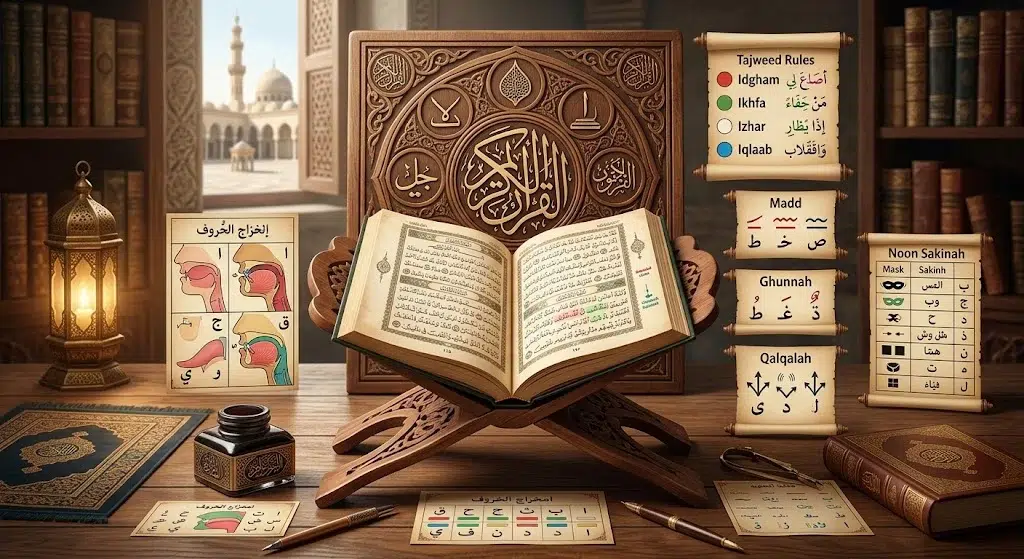
Tajweed developed through the careful transmission of Quranic recitation from the Prophet Muhammad, peace and blessings be upon him, to his Companions and subsequent generations. Its principles were preserved through oral teaching and reliable chains of transmission before being organized into systematic rules by scholars of Quranic recitation.
The ten recognized reading traditions are associated with distinguished recitation imams and their transmitters. These traditions preserve established methods of reciting the Quran. The Hafs narration from Asim, transmitted through the Shatibiyyah route, is among the most widely used and is the narration adopted in the material presented here.
How do you memorize Tajweed rules?
Memorizing Tajweed rules requires a combination of theoretical knowledge, listening, repetition, and correction. Learners should study one rule at a time, understand its letters and conditions, and practice it in Quranic examples.
Teacher
Learning with a qualified Tajweed teacher allows students to receive direct feedback on articulation points, letter characteristics, Ghunnah, and Madd durations. A teacher can identify errors that may be difficult to recognize independently.
How to Get Ijazah in Tajweed What Is Tajweed Rules Ijazah ?
An Ijazah is connected to an established chain of transmission and demonstrated proficiency in Quranic recitation. Learners generally need to study with a qualified teacher, practice the relevant narration, and recite the Quran accurately before receiving certification. The exact requirements depend on the teacher and the recitation tradition.
Diagrams
Charts and diagrams help learners organize related rules, compare pronunciation categories, and remember the letters associated with each rule. A structured Madd chart, for example, can clarify the differences between natural and secondary elongation.
Recordings
Listening to accurate Quran recitations helps students recognize correct pronunciation, rhythm, and elongation. Recording personal practice and comparing it with a qualified reciter can also reveal areas that need improvement.
Online Groups and Communities
Online learning groups provide opportunities to exchange questions, review rules, and maintain consistent practice. Learners should prioritize reliable instruction and qualified teachers when studying Quranic recitation.
Benefits of learning Tajweed Rules
Learning Tajweed helps Muslims recite the Quran with greater accuracy and avoid clear and subtle pronunciation errors. It develops awareness of Arabic articulation points, letter characteristics, nasalization, and elongation.
Tajweed also encourages careful listening, patience, and reflection on Quranic verses. By learning What Is Tajweed Rules systematically and applying them through guided practice, beginners can develop a stronger foundation for consistent Quran recitation.
itqan helps to improve communication skills in Arabic
Itqan helps beginners develop their understanding of Arabic through structured learning and guided practice. Improving Arabic pronunciation and recognizing the characteristics of its letters can support clearer communication while strengthening the foundational skills needed for Quran recitation.
For learners beginning their journey with Arabic and Tajweed, consistent practice, reliable instruction, and a clear understanding of the rules provide a practical path toward greater confidence and accuracy.